_edited.png)

Private Label Supplement Manufacturing in India: A Guide to Custom Wellness Brands with Giva Agro.
- Giva Agro
- 16 minutes ago
- 3 min read


Building a Private Label Wellness Brand:
What Giva Agro Brings to the Table
The wellness industry has never had more entrants, and never had a lower barrier to launching a brand — provided you have the right manufacturing partner behind you. That's where private label and OEM (Original Equipment Manufacturer) production comes in: instead of building a factory, formulating from zero, and sourcing raw ingredients yourself, you partner with a manufacturer who already has the infrastructure, certifications, and supply chain in place, and you put your label on it.
Giva Agro, based in Dehradun, India, is one such manufacturer. The company has built its business around essential oils, Himalayan Shilajit, and herbal tea blends, and offers OEM and private label services so brands can launch custom-formulated personal care and wellness products under their own name. With registered offices in France, New Zealand, and Australia alongside its India operations, and certifications including HACCP, FDA, GMP, and ISO, it's positioned to serve both domestic and export-focused brands.
Why Private Label Makes Sense for Wellness Brands
Formulating a supplement or herbal product from scratch is slow and expensive. It means sourcing raw ingredients at scale, validating formulations, securing manufacturing certifications, and building quality control processes — all before you've sold a single unit. Private label manufacturing shortcuts that process. A brand can instead focus on what actually differentiates it in a crowded market: positioning, packaging, storytelling, and distribution — while an experienced manufacturer handles formulation, compliance, and production.
This is particularly relevant in categories built around traditional or regionally-sourced ingredients, where the manufacturer's access to authentic raw material matters as much as the production line itself. Himalayan Shilajit is a good example: it's a mineral-rich resin traditionally used in Ayurvedic wellness practices, and sourcing it authentically from the Himalayan region is a meaningful differentiator that's hard for a new brand to replicate on its own.
What a Custom Product Line Could Look Like
For a brand building a wellness catalog through a private label partner, the category possibilities are broad. A Himalayan Shilajit extract sits naturally alongside adaptogenic mushroom blends, immunity-focused formulations, and targeted men's and women's wellness lines — the kind of range that lets a brand serve multiple customer needs under one label while keeping formulation and manufacturing with a single partner. Personal care extensions, drawing on the same essential oil and herbal expertise, are a natural next step for brands that want to grow beyond a single product category.
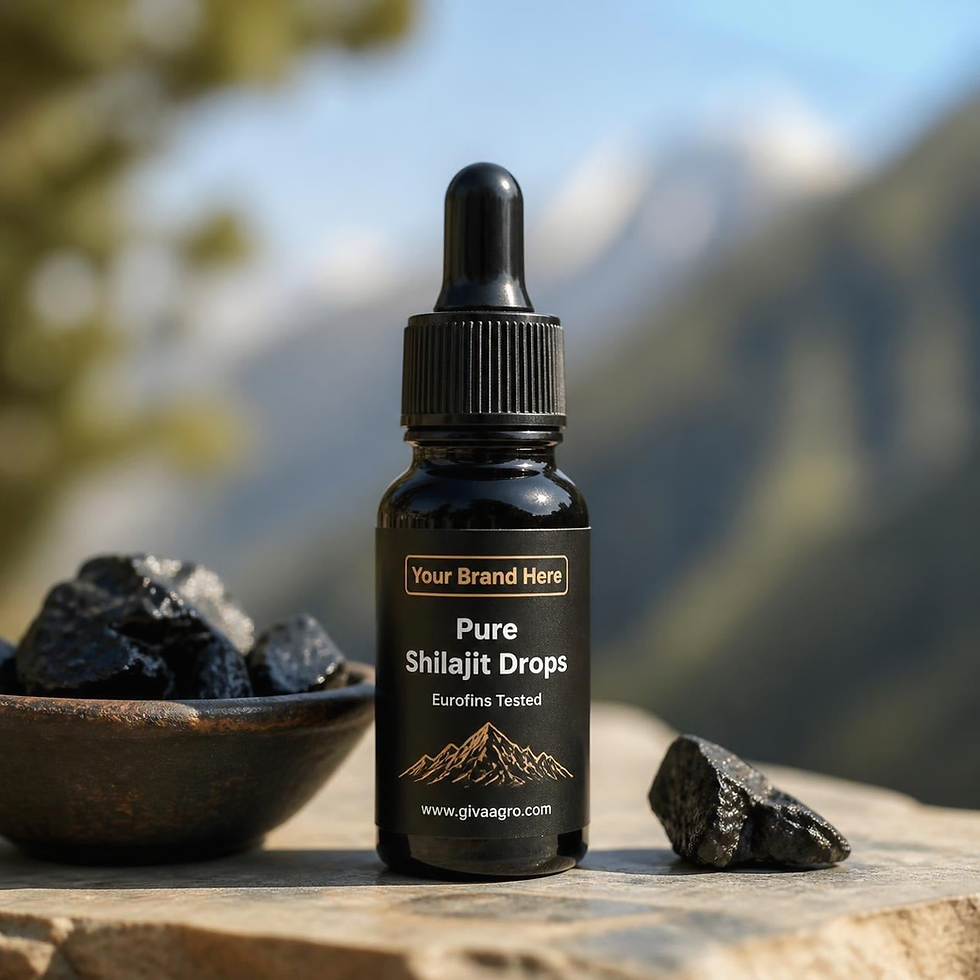
The specific bottle mockups shown above — spanning immunity, adaptogenic mushrooms, men's and women's formulas, Shilajit extract, and a nootropic blend — are illustrative examples of how such a range could be branded and shelved together, rather than an existing, certified product catalog. Any brand pursuing a line like this would work directly with the manufacturer to confirm formulation, certification, and label compliance for each specific product and target market.
What to Ask Before Choosing a Manufacturing Partner
Before committing to a private label partner, it's worth getting clear, documented answers on a few things: which certifications actually apply to the specific products you want (not just the company overall), where raw ingredients are sourced from and whether that's verifiable, what the minimum order quantities and lead times look like, and how label and regulatory compliance is handled for your target market — since supplement labeling rules vary significantly between countries.
The Takeaway
Private label manufacturing lowers the barrier to launching a wellness brand, but it doesn't remove the need for due diligence. A manufacturer with real infrastructure, verifiable certifications, and an authentic ingredient story — like Himalayan-sourced Shilajit — gives a new brand a credible foundation to build on. The rest, from category selection to packaging to go-to-market, is where the brand itself has to do the work.
private label supplements, OEM manufacturing, Himalayan Shilajit, wellness brand, nutraceutical manufacturing, supplement packaging


Comments